

Accurate time tracking is the first step toward reliable construction payroll and job costing.
Construction projects rarely happen in one place. Crews move between job sites, different trades work overlapping schedules, and supervisors often manage several teams at once. In that environment, tracking labor hours accurately becomes more complicated than it sounds.
Time tracking is not just about recording when someone starts and ends their day. The hours worked in the field ultimately drive payroll, labor reporting, and job costing. If the information coming from the job site is incomplete or inaccurate, it can create problems throughout the rest of the business.
Many contractors discover that payroll issues, labor overruns, and reporting inconsistencies often trace back to how time is captured in the field.
For that reason, reliable time tracking is one of the most important operational systems construction companies rely on.
Why Time Tracking Is Difficult in Construction
Tracking time in construction is different from most industries because the workforce is constantly moving.
Employees may start their day on one job site and finish it on another. Crews may split time between tasks that require different labor classifications or cost codes. Supervisors are responsible for reviewing and approving hours while also managing project progress.
These realities create several challenges.
Paper time sheets can be lost or submitted late. Workers may forget to record hours during busy days. Supervisors sometimes spend significant time reviewing and correcting information before payroll can be processed.
Even when companies rely on spreadsheets or email submissions, the process still depends on manually collecting and verifying information from multiple job sites.
As projects grow larger and teams become more distributed, these manual processes become harder to manage consistently.
Where Time Tracking Breaks Down
Time tracking problems usually appear in a few predictable places.
The first challenge is collecting hours from the field. Crews working across multiple locations often submit time sheets at different times or in different formats. When information arrives late or incomplete, payroll teams must spend additional time correcting records.
Another issue involves labor coding. Construction projects depend on accurate cost codes and labor classifications to understand how time is being spent. When hours are coded incorrectly, project reports and job costing data become unreliable.
Supervisors also need time to review and approve hours before payroll is processed. If approvals are delayed or inconsistent, payroll timelines can quickly fall behind schedule.
These breakdowns are not usually caused by negligence. They occur because the process of collecting, reviewing, and transferring time data involves many moving parts.
Reliable construction time tracking helps ensure that hours are captured consistently and routed through the correct approval process.
The Payroll Impact of Inaccurate Time Tracking
When time tracking problems occur in the field, payroll teams are often the first to feel the impact.
Missing or inaccurate time cards can delay payroll processing, create wage discrepancies, or require additional review before hours are finalized. Payroll administrators may spend significant time correcting entries, verifying hours with supervisors, or tracking down missing information.
Accurate time data also affects project reporting. Labor hours feed directly into job costing and financial reporting, which project managers rely on to monitor budgets and evaluate project performance.
If time tracking data is incomplete or inaccurate, it becomes difficult to compare labor costs against project estimates or identify areas where productivity may need improvement.
These challenges are why many contractors view time tracking as the foundation of both payroll accuracy and project visibility.
What Contractors Are Doing to Improve Time Tracking
Many construction companies are moving away from manual processes and adopting tools that allow crews and supervisors to capture time directly from the field.
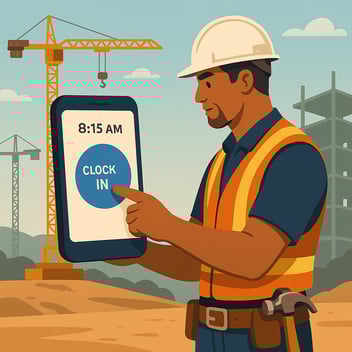
Mobile time entry allows employees to log hours using smartphones or tablets, reducing the need for paper time sheets that must later be collected and entered manually. Supervisors can review hours in real time and submit approvals before payroll deadlines approach.
Digital systems also help ensure that time is associated with the correct job site, crew, and cost codes. This makes labor reporting more reliable and allows accounting teams to move payroll data directly into financial systems without extensive manual review.
Many contractors begin by simplifying their construction time tracking process before adopting more advanced tools designed specifically for construction workflows.
Time Tracking Tools Built for Construction
Construction companies need time tracking tools that work in both the field and the office.
Supervisors need visibility into crew hours as work progresses. Payroll teams need accurate data that can move quickly into payroll systems. Project managers need labor information that helps them understand how crews are spending time across job sites.
Purpose-built systems for construction connect these pieces together.
Digital time cards allow crews to record hours quickly from the field. Supervisors can review and approve time through defined workflows. Payroll teams receive consistent, structured data that reduces manual corrections and speeds up payroll processing.
When time tracking systems connect with accounting and payroll platforms, labor hours can move directly from the job site into payroll and financial reporting.
Many contractors achieve this by implementing construction time tracking software designed specifically for construction operations. These platforms allow field teams to enter hours, route approvals, and synchronize labor data with payroll and accounting systems.
How hh2 Helps Contractors Track Time More Accurately
Construction companies need time tracking tools built for the realities of job sites, field crews, and payroll deadlines.
hh2’s construction time tracking software allows crews to submit time cards directly from the field using mobile devices. Instead of collecting paper time sheets at the end of the week, hours are recorded while work is happening.
Supervisors can review and approve hours quickly through structured approval workflows, helping ensure payroll stays on schedule.
Because hh2 connects labor hours with project information like cost codes, time data flows directly into accounting systems and supports more reliable job costing and financial reporting.
Payroll teams no longer need to spend hours correcting entries or chasing down missing information. Field data moves directly into payroll systems, helping contractors maintain consistent labor records across every job site.
For companies looking to simplify how crews record time and how payroll processes those hours, implementing construction time tracking software built for construction can make a measurable difference.
See hh2 Time Tracking in Action
Capturing accurate labor hours across job sites does not need to be complicated.
hh2 helps construction companies streamline time entry, route approvals, and synchronize labor data directly with payroll and accounting systems.
Schedule a demo to see how construction time tracking software from hh2 helps contractors simplify field time capture, improve payroll accuracy, and maintain clear visibility into labor hours across projects.
Simplify Construction Time Tracking
Capture crew hours directly from the field, route approvals faster, and connect labor data to payroll and job costing with hh2’s construction time tracking software.
Blog Transcript



.png?width=352&name=image%2038%20(1).png)