

Company Snapshot
Company Overview
Santarossa Mosaic & Tile has been in business in Indianapolis since 1923, installing tile, terrazzo, carpet, vinyl, and countertops on commercial and residential projects across the region. The company runs a union shop with two trades on the books: bricklayers (finishers and setters) and carpenters. About 80 field employees and 20 office staff round out the team.
It is, in Brenda Smith's words, "a very tight-knit family kind of atmosphere." Brenda joined Santarossa eight years ago, and after completing her degree was recently promoted to Controller. The office shares its space with two cats (Thanos and Nero), a bearded dragon, and a shop cat named Ginger. Change, she'll tell you, is not something this team takes to lightly.
Payroll & Compliance
The challenge: Paper files, phoned-in time, and a tech stack that couldn't keep up.
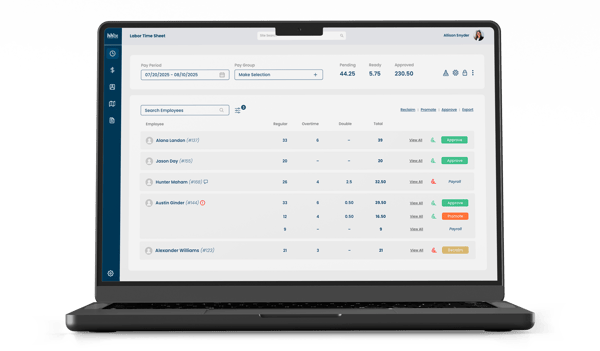
Before hh2, payroll at Santarossa was a paper operation. Field crews phoned in their hours each week. The payroll processor wrote everything down on time cards, then keyed each line into Sage 300 by hand. Start to finish, the run could eat two and a half days, and it still cut close to the bank deadline.
HR was no different. Personnel records lived in filing cabinets. Then a roof leak destroyed the cabinets, and there were no backups.
Sage 300 had been the company's accounting system for two decades, and it kept doing its job. The challenge was the workflow around it. Travel and per diem amounts came in as units with no rate attached. Custom reports required hand-built conditions. Remote access meant a remote desktop session every time a question came in from the field. And when a five-year union audit landed, the team realized just how much manual lift it would take to pull what the auditors needed.
Santarossa briefly tried a competing platform's time tracking. The field rejected it. Line-by-line, day-by-day entry was too much overhead for crews whose job is production, not data entry. Within three months, the team was using hh2.
The solution: Built natively for Sage 300. Adopted module by module.
Santarossa's path to hh2 happened in pieces, in the order each problem became urgent. That's how most contractors actually adopt back-office software. Each layer reinforced the value of the next.
FIRST |
THEN |
NEW |


.svg)
For Brenda, the deciding factor was the depth of the integration. "It was very important that the two worked well together," she explains. hh2's modules were built natively for Sage 300, which means data moves between the two systems without middleware, custom imports, or recurring cleanup. Time tracking, AP, and payroll all share the same source of truth as Sage. For Santarossa, the practical effect is that the two systems behave like one.
That depth of integration is also why hh2's implementation methodology includes a forensic look at the data already flowing through Sage. Setups that have run unchallenged for years sometimes turn out to have quiet errors built into them. Santarossa's did.
Ready to simplify time and payroll for your business?
See how our construction-specific payroll solution can eliminate compliance risk and
save your team hours every pay period. Schedule a personalized demo today.